
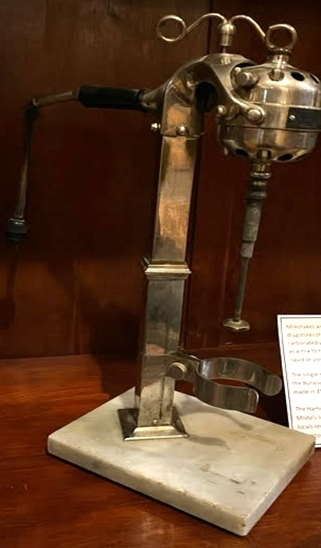
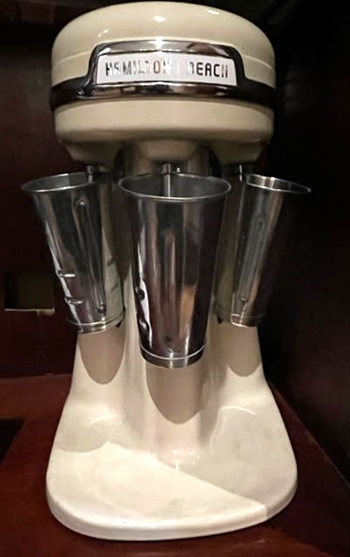
At first glance, this object may seem like no more than a metal bucket with a peculiar lid. This artifact, however, is a descendant of a key piece of culinary history. It is an antique ice cream mixer from the 1940s-1950s. In fact, the museum houses a few other ice cream related artifacts including a 1915 single stem malt milk mixer used in the local Burleson’s drugstore and a 1950s milkshake machine!
Today, most of us enjoy our ice cream ready-made, purchasing it from local grocers or ice cream parlors, but this is a modern luxury.
Until the mid-1800s ice cream was reserved as a treat for the wealthy who could afford private cooks and ice houses. The first step towards more people being able to enjoy this dessert was in 1718 when Mary Eales published the first English cookbook with an ice cream recipe.
But it wasn’t until 1843 when American Nancy Johnson patented the first hand-cranked ice cream mixer that this frozen treat could truly be enjoyed by the masses. Her invention was called the “Artificial Freezer.” It was a wooden tub that contained salt and ice fitted with a hand crank and paddles. This meant that when cream was added, it could be churned whilst being cooled.
This small, home cook friendly invention made the production of ice cream accessible to ordinary people, who if they were willing to use a bit of muscle, would be rewarded with a sweet dessert.
It is a testament to Johnson’s ingenuity that hand cranked ice cream machines continued on even a century later as is evidenced by the ice cream mixer housed at Riverton Museum. Even modern electric ice cream makers still use the same principles as Johnson’s creation.
Another key development in the history of ice cream was the ice cream cone. You can thank one Agnes Marshall for that sweet invention. Marshall, a Victorian culinary pioneer, often referred to as the “Queen of Ices,” founded a culinary school in London and wrote many cookbooks. She created molds and appliances that made frozen treats accessible to a wider variety of people. Her invention of the ice cream cone is attributed to her 1888 cookbook which is the first mention that ice cream could be enjoyed “on the go” with the use of a baked cone.
So, come check out these relics of the culinary past. The milkshake machine and single stem malt mixer are currently on display at Riverton Museum. And to all you ice cream lovers, next time you find yourself enjoying an ice cream (cone or otherwise) consider saying a thank you to these innovative women who democratized this sweet treat for the masses.
Next up for the Fremont County Museum
October 15, 6pm at the Riverton Museum, “Fremont Haunts w/Alma Law” Wyoming Community Bank Discovery Speakers Series
October 17 & 18, 6-9pm at the Pioneer Museum, “Halloween Night at the Museum” Bailey Tire/Pit Stop Children’s Exploration Series
October 18, 5:30 with the Riverton Museum, “Downtown Riverton Haunted Trek” Wind River Visitors Council Adventure Trek Series
October 24 & 25, 11am at the Dubois Museum, “Kids Corner: Spooky Halloween Characters” Bailey Tire/Pit Stop Children’s Exploration Series
October 25, 2pm at the Riverton Museum, “Fall Fun Fest”
October 25, 3pm at the Dubois Museum, “Annual Halloween Carnival
Thru December, 9-5 at the Riverton Museum, “History Day Exhibits” Shoshone Schools
Call the Dubois Museum 1-307-455-2284, the Pioneer Museum 1-307-332-3339 or the Riverton Museum 1-307-856-2665 for detail regarding their programs.
The Dubois Museum, the Pioneer Museum in Lander and the Riverton Museum need your financial support. In the current economic environment, the museums are more reliant than ever on donations from the private sector to continue to provide the quality programs, collections management, exhibits and services that have become their hallmark over the last four years. Please make your tax deductible contribution through the Wind River Cultural Centers Foundation www.windriverccf.com or by sending a check to Fremont County Museums 450 N 2nd Rm 320 or taking it directly to the museum you choose to support.

