
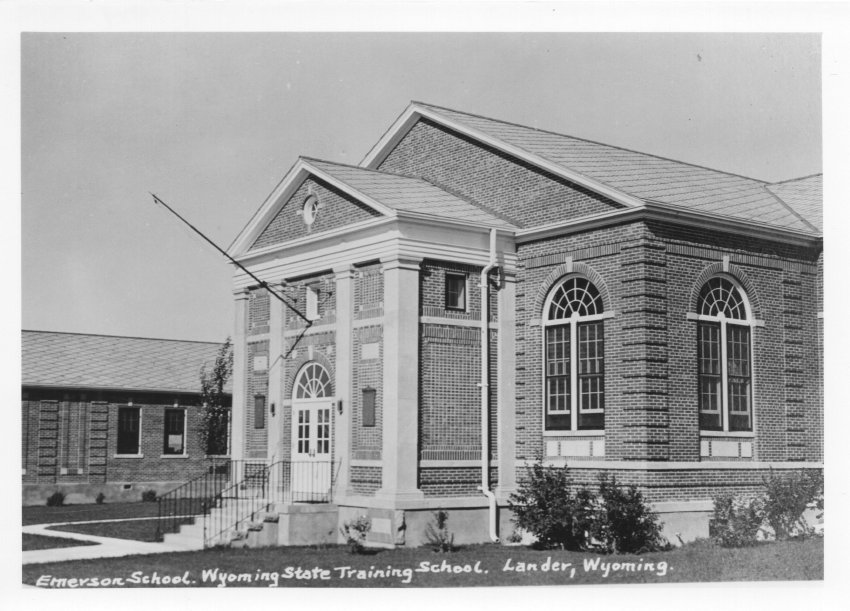
The early roots of the Wyoming State Training School go back to Territorial Wyoming 1888. In that legislature up to $25,000 was appropriated for a State Poor Farm to care for people who could not care for themselves. Land was purchased close to Borner’s Garden up Sinks Canyon for the project, but little else was done and the remaining funds remained unspent.
In 1906 Governor Brooks became interested in providing institutional care for citizens with disabilities. Two legislators from Fremont County, Dr. Denis Godfrey and Robert Hall introduced a bill in February of 1907, “to establish a home and training school for the feeble minded and epileptic, assigning the lands and property of the State Poor Farm to that purpose making appropriations for the same...”. In 1909 members of the State Board of Charities, which included the Governor, the Secretary of State and the State Superintendent, visited Lander to look for a site for a school for the
“feeble minded and epileptics”. The wording sounds harsh to modern ears, but it was a different time with different sensibilities. They decided on a tract of land of a little more than 100 acres on a bench overlooking the Popo Agie river just east of Lander. The Iiams family was paid $6000 for the land. The tract of land at Borner’s Garden was also sold for $6000 in that same time frame. On March 1, 1911 the name of the school was changed to “Wyoming Home for Defectives.” Dr. Thomas Maghee, an early physician who had served at Camp Auger was appointed Superintendent of the School and the first patients were admitted June 20, 1912 and by the end of 1912, 23 students lived at the school. Dr. Maghee had some success treating his epileptic charges by calming their seizures with drugs and making many of their lives more functional. On February 21,1921 the name of the school was changed to The Wyoming State Training School. By 1923 the population of the school had increased to 156. In the early days elderly and orphans were also housed at the Training School.
An unsigned editorial in the paper from 1923 complained about the number and the expense of keeping feeble minded people. It seemed to link everything from rising crime to tuberculosis and venereal disease to the feeble minded and seemed to advocate for forced sterilization. The article quotes from a publication by the National Committee for Mental Hygiene:
“Mentally defective persons, by reproducing their kind, provide an endless stream of defective progeny who are a serious drain upon the resources of the nation.”
The pseudoscience of eugenics was growing in popularity at the time and would culminate in Nazi Germany with the theory of a superior Aryan Nation and the deaths of six-million European Jews in the Holocaust. In spite of this, the Wyoming State Training School continued to provide compassionate care for their students in accordance with the standards of the time.
Mrs. Betty Henry started working at the State School in 1920 and spent a 40-year career there working as a teacher. She taught music, weaving and knitting and for a time kindergarten to residents of the school. When she was interviewed upon her retirement, she was supervising a knitting class who were making gifts for Parents’ Day.
In 1931 the ground was broken for the Emerson Building. The building would include a gymnasium which could accommodate a theater. It also contained classrooms and living quarters. The Emerson building became the social center of the school.
The State School continued to grow. Today agricultural land has been added and the Honor-Farm inmates manage a herd of cattle on the property. Luckey Pond, named for former residents of the State School, is used as a fishing pond and picnic area by many Lander people. Many of the resident’s cottages were named for former governors or former superintendents. Today, the campus covers 474 acres.
The school reached its highest enrollment in 1972 with 740 students living at the State Training School. That year Public Law 94-142 mandated that students with disabilities from age 3 to 21 must be educated in the least restrictive environment and with their general education peers to the maximum extent possible. Grants were obtained and The Community Entry Service started operating in the old federal building assisting former state school residents in finding placements in the community. Enrollment steadily dropped at the State School as students were returned home or placed in group homes or independent living homes.
In 1990, before the Americans with Disabilities Act, a class action suit titled, Weston vs Wyoming State Training School was brought before a judge. The court found in favor of Weston, and reforms were instituted at the Training School such as more individualized assessment of the students and more privacy for residents. The changes improved the quality of life for the residents.
In 2008 the name of the school was changed again to the Wyoming Life Resource Center. They no longer serve minors but, “provide high-level intermediate and long term care and services to individuals in Wyoming who are hard to place, who have high medical needs or with exceptionally difficult behaviors.” People with acquired brain injury are also served at the Life Resource Center. Today the census at the center is 47 with a waiting list. They could accommodate up to 100 individuals if staff was available.
Society’s treatment of the disabled has evolved since the state first instituted a school for the disabled in 1906. Treatment has become a much more humane, compassionate and inclusive way to treat our fellow citizens.
Next up for the Fremont County Museum
October 24 & 25, 11am at the Dubois Museum, “Kids Corner: Spooky Halloween Characters” Bailey Tire/Pit Stop Children’s Exploration Series
October 25, 2pm at the Riverton Museum, “Fall Fun Fest”
October 25, 3pm at the Dubois Museum, “Annual Halloween Carnival
November 4, 6-8pm with the Riverton Museum, “Trivia Night” at the Riverton Branch Library
November 13, 6pm at the Riverton Museum, “Preserving Personal Photographs and Heirlooms” Wyoming Community Bank Discovery Speakers Series
November 15, 1pm at the Pioneer Museum, “Christmas Stocking Party” Bailey Tire/Pit Stop Children’s Exploration Series
Thru December, 9-5 at the Riverton Museum, “History Day Exhibits” Shoshone Schools
Call the Dubois Museum 1-307-455-2284, the Pioneer Museum 1-307-332-3339 or the Riverton Museum 1-307-856-2665 for detail regarding their programs.
The Dubois Museum, the Pioneer Museum in Lander and the Riverton Museum need your financial support. In the current economic environment, the museums are more reliant than ever on donations from the private sector to continue to provide the quality programs, collections management, exhibits and services that have become their hallmark over the last four years. Please make your tax deductible contribution through the Wind River Cultural Centers Foundation www.windriverccf.com or by sending a check to Fremont County Museums 450 N 2nd Rm 320 or taking it directly to the museum you choose to support.

